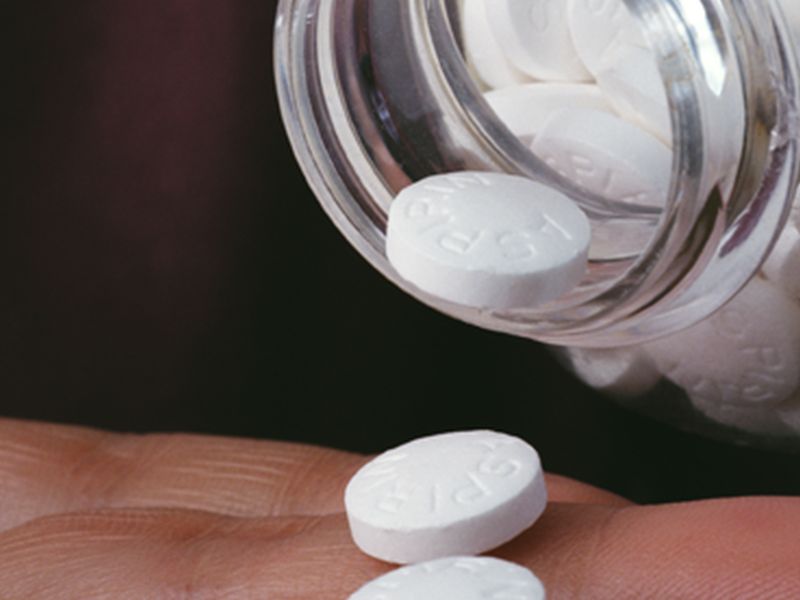
Taking a daily low-dose aspirin may speed the progression of cancer in the elderly, a new clinical trial shows.
Daily aspirin doubled the risk that a person 70 or older would die from a stage 3 cancer, and increased the death risk associated with stage 4 cancers by nearly a third, according to data from more than 19,000 older people in the United States and Australia.
Older patients taking daily aspirin also had a roughly 20% increased risk of their cancer spreading to other parts of their body either before or after diagnosis, the researchers found.
Compelling evidence from earlier clinical trials had shown that daily aspirin taken by middle-aged folks could reduce the risk of cancer, particularly colon cancer, researchers said in background notes.
But in this new trial, the investigators found that elderly people who presented with later-stage cancers "tended to do worse if they were on aspirin," said senior researcher Dr. Andrew Chan, director of epidemiology at the Massachusetts General Hospital Cancer Center, in Boston. "It does suggest there is a potential difference in the effect of aspirin on older adults compared with younger adults."
Based on these new findings, older people should have a serious discussion with their doctor before starting a course of low-dose daily aspirin, said Dr. Frank Sinicrope, a gastrointestinal cancer specialist with the Mayo Clinic in Rochester, Minn.
"This study certainly raises concern over the use of low-dose aspirin in people over the age of 70. It raises concern about the potential for more advanced cancers to develop in these older patients," Sinicrope said. "I think it's something they would need to discuss with their doctors, to see what the risk/benefit would be."
For the clinical trial, the researchers randomly assigned people aged 70 or older to take 100 milligrams a day of either aspirin or a placebo for an average of nearly five years. The vast majority of study participants did not take daily aspirin before age 70.
Out of just over 19,000 participants, 981 taking aspirin and 952 taking a placebo developed cancer during the follow-up period.
Analysis revealed that low-dose aspirin was not associated with a higher risk of developing cancer, Chan said, but that it did appear to be linked to more aggressive cancer.
"Scientists have assumed aspirin works the same in all individuals, but the effect may be different in older adults," Chan said.
There are two theories why this difference between middle-aged and elderly aspirin users exists, he noted.
One is that aspirin's anti-cancer benefit might only work if people start taking aspirin at an earlier age. "When you start taking it when you're older, it may be too late," Chan explained.
The other theory is that cancers in older people are somehow different than those in younger people.
"Those cancer mechanisms may be different and may be less sensitive to aspirin than cancers that dwell in younger adults," Chan suggested.
These results were a "huge surprise" to Peter Campbell, scientific director of epidemiology research for the American Cancer Society.
Larger studies involving more clinical trial data are needed to further clarify this odd difference between younger and older folks, he said.
"These results conflict with a lot of larger studies showing either no harm or a net benefit with aspirin," Campbell said.
Comments
Post a Comment
Please, tell us how we may be of help to you